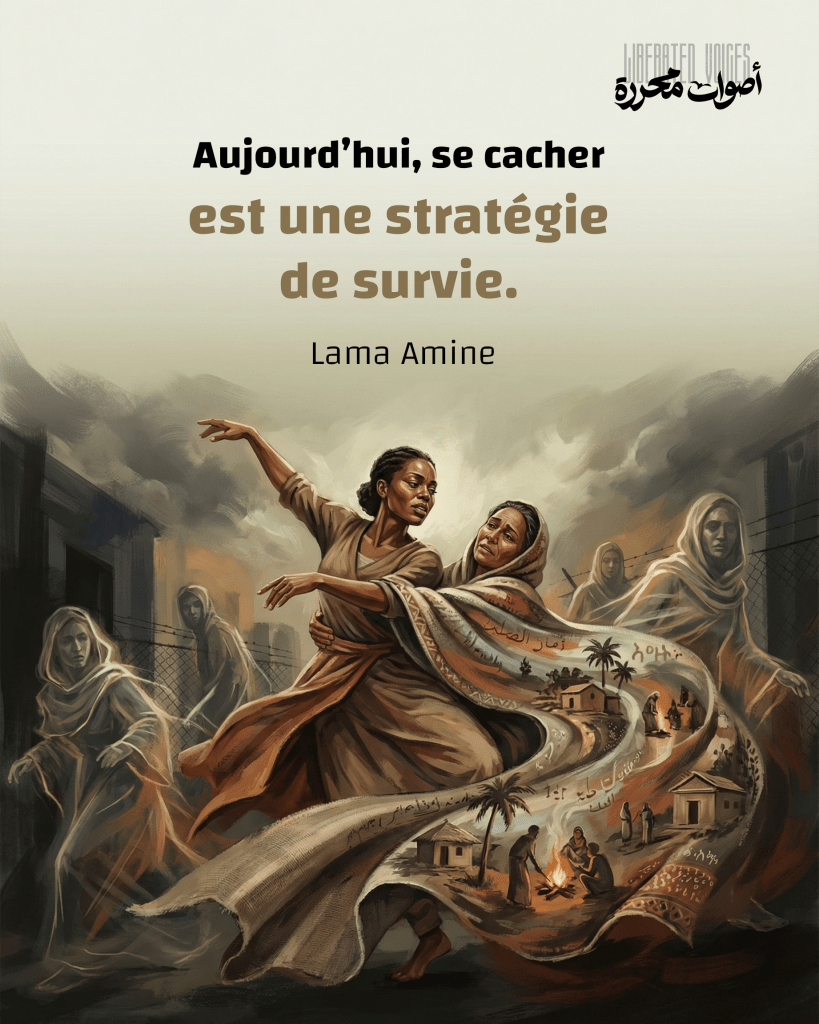
When Bodies Remember: Stories of Migration and Movement
Dancing Out of the Cage: Black Women Finding Voice Through Movement
Introduction
My name is Lama Amine. I’m a theatre director, movement director, and performer. I studied acting in Lebanon and completed my Master of Fine Arts in Drama at the Royal Central School of Speech and Drama in London.
I now work as Director of Arts at Seenaryo, an organisation working with unprivileged communities in Lebanon, Syria, Jordan, Palestine, and London. We create plays from scratch with women, children, men, youth, and LGBTQ+ communities. I also work as an independent artist, making my own plays and mentoring actors and directors in Saudi Arabia, London, Jordan, and Lebanon.
The Project
I received funding from AFAC to re-adapt Jean Genet’s The Maids, a topic I’ve always wanted to explore. I grew up in Lebanon as a Black Lebanese person, which was not an easy life. Theatre became my platform to speak about these experiences. An incident at Beirut Airport last July pushed me further to tell this story.
The first phase of the project involves workshops with migrant workers and Black women in Lebanon. I put out a call for participants, and the response from women was strong. What I’m sharing here is my work with them from sessions 1 to 4, out of 10 sessions I’m leading. We may end with a short 10-minute performance, but the true aim is for the women to connect with their bodies, create their own stories through movement, and share experiences related to the Kafala system and racism in creative ways. which Kafala system mean? “ A sponsorship system that binds migrant workers to their employers, often leading to exploitation and abuse”
Session One
Working with these women felt like a dream come true. I remember walking into the MCC (Migrants Community Centre), where the sessions are held, and feeling the warmth of being among so many Black people in Lebanon, treating each other like family.
When I asked the women to stand in a circle, I hesitated to speak too much about myself, preferring to start with the work. But their expectant looks made me share why I was running these workshops and how happy I was to be working with “my people.” Many recognised me from a viral video, but they didn’t know I’m an artist. When they heard I was creating a play about the Kafala system, colour, racism, and discrimination, I saw how much they appreciated it and wanted to support the project.
All sessions begin with check-in, games, and warm-up before moving into improvisations. In session one, my aim was for them to understand how to move together as an ensemble and how to use breath to cross a circle and reconnect with others. I asked them to make eye contact, breathe, and notice how it felt to move across the room among people they didn’t know.
Some experienced unexpected emotions. Someone felt like she was at the airport saying goodbye to someone. Another woman felt she was in nature, walking freely. A different person imagined dancing by the sea. Another person felt she was walking with her extended family. All from the simple act of crossing the circle.
Next, I asked them to move without letting their mind lead. Many connected to their childhood. Someone said she felt like a young child playing freely. Basma imagined dancing with her father, whom she hasn’t seen for a long time. Another woman felt like a bird freed from a cage.
Observing their energy was fascinating. I initially told them to stay in their own space, moving with open or closed eyes. But within minutes—and without being told, they began dancing with each other. They moved from individual movement to eye contact, to touching, to shared movement. Their energy rose quickly, and I helped them regulate it safely. In theatre workshops, these steps usually build slowly, but they moved through them naturally and quickly.
Session Two
By the next session, I realised they were ready for more than I had planned. I intended to go gradually, but their excitement pushed them ahead. They moved quickly through the steps, showing how open and eager they were.
Listening to their stories is a huge responsibility. I shape each session based on what they share, keywords, recurring themes, and what matters to them. For this session, I asked them to explore stories about childhood, a dream, a challenge, and a celebration.
Their childhood stories were vivid. Someone recalled pretending to be sick so she could cheat on an exam in a separate room. Another woman calm in the workshop revealed she used to be the troublemaker at school, though no teacher suspected her.
Most dreams involved leaving Ethiopia, Egypt, or Sudan. Some hoped marriage would allow them to travel, and others wished to reach Europe. Many dreamed simply of owning a home, anywhere safe.
For challenges, every woman spoke about death or losing someone. One received news of her brother’s death while in a van on the way to work and had to continue her day. Another gently described losing a friend within a day of being told she was sick. Her body language, lifting her shoulders and taking a deep breath, aids everything.
Their way of speaking about death, almost as if it vanished quickly, was striking. But it made sense: they live in a country that is not their own, often with restricted rights and heavy responsibilities. They support families, raise children, and manage problems one at a time. They live in survival mode.
Their celebrations mostly centred on others: a child passing exams or graduating, or reunions after many years apart. Someone celebrated seeing her mother and uncle after 18 years in Eritrea. Another person celebrated being blessed with another child.
Movement Work
After sharing stories in small groups, I asked them to choose one feeling or verb for each story and create four movements. I did not give limitations; I wanted to see what emerged naturally. Their movements showed depth and honesty, shifting from one feeling to another without acting or forcing memory. They worked in the present.
Each woman invited others into four parts of her life. Two women chose not to share, and I respected that. One later told me the exercise was hard because of what she had lived through. I reminded them that MCC staff are always available if they want to talk.
I’m very happy to share these observations. I can’t wait to see what the women will create, it is a joy working with them.
 Liberated Voices
Laisser un commentaire